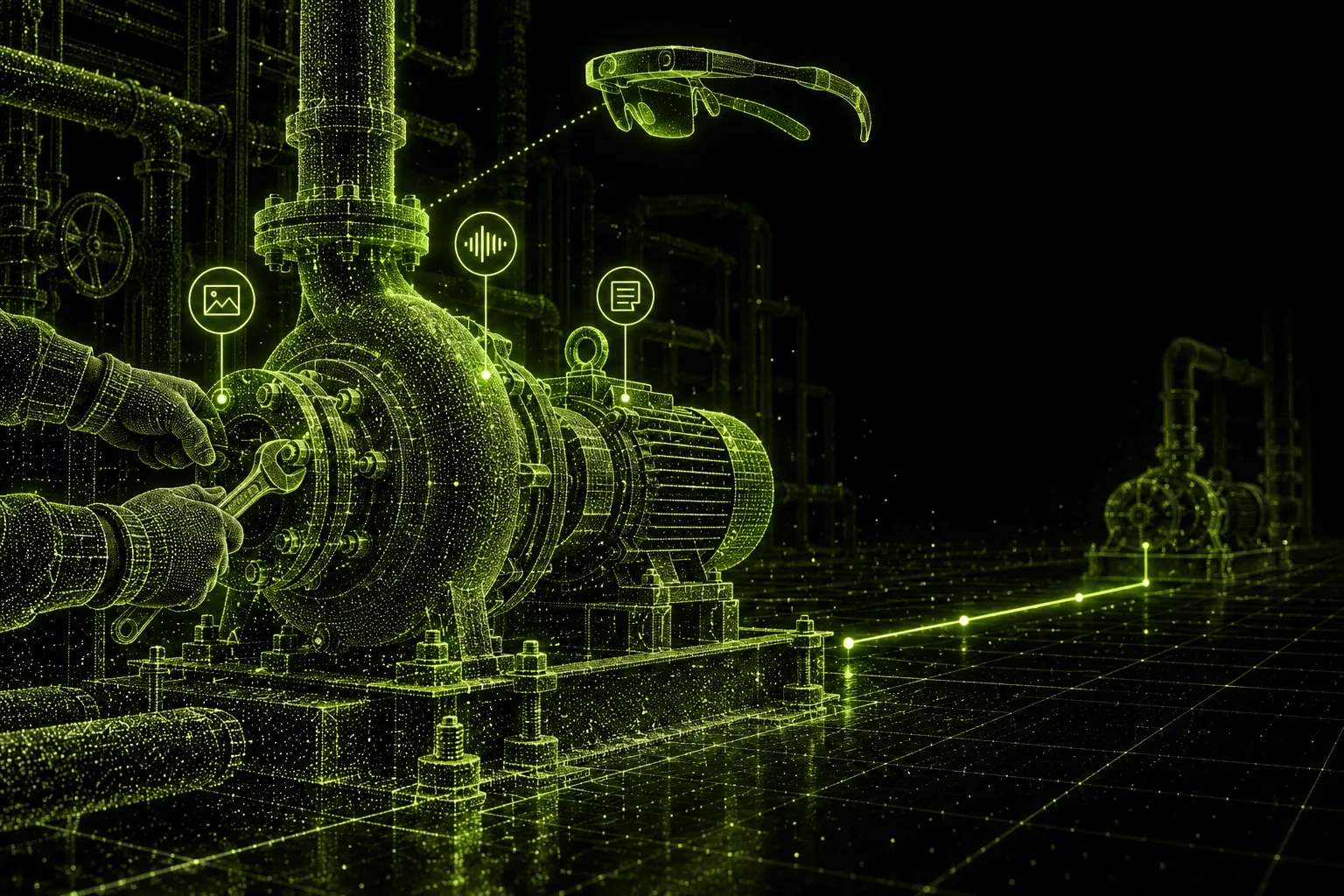
The current wave of AI is aimed mostly at desk work: writing, code, documents, meetings. But a large part of the economy happens somewhere else: in engine rooms, on plant floors, in substations, on job sites and in service vans. The people who work there have their hands full and their eyes on the equipment, and almost none of today's AI reaches them. That's the opportunity: not another tool for the desk, but help that comes to the work.
Help in the moment of need
At a desk, help is always close: search, documentation, a colleague on chat. On a ladder or in an engine room, it's a walk, a phone call or a guess away. AI built for hands-on work closes that distance. The technician asks out loud, the system already sees the equipment, and the answer arrives while both hands stay on the job. Why smart glasses explains why the interface matters so much.
Physical work is full of exceptions: corroded fittings, undocumented modifications, equipment older than the people servicing it. That's where experience counts most, and where AI is most useful as backup for it: the procedure, the history and, when it's needed, another person. The technician makes the call, with more to go on.
Know-how that stays, with a name on it
Ask any maintenance lead where the real knowledge is, and they'll point to people: the technician who knows this pump always loosens at the same flange, the engineer who remembers what was changed two refits ago. That knowledge is rarely written down where the next person can find it. Work orders say what was done, not what the equipment looked like or why a choice was made.
Augmentation keeps it. What a technician chooses to capture stays with the asset, credited to them, so the next repair no longer starts with reconstructing the last one. It starts from what was seen and done.
What augmentation looks like on the job
01 · SEE
See what the technician sees
Guidance starts from the actual equipment, not from a description typed into a box.
Ruvi stack · See
02 · CAPTURE
Capture on the technician's terms
A photo, a short clip or a voice note, saved when they say so and credited to them.
Ruvi stack · Remember
03 · RETRIEVE
Retrieve with evidence
Answers point back to the source observation, so they can be checked.
Ruvi stack · Know
04 · GUIDE
Guide the next step
Procedures and history arrive at the moment of need, hands-free.
Ruvi stack · Assist
05 · ESCALATE
Escalate to a person
When AI isn't confident, a senior technician or remote expert is one call away.
Ruvi stack · Escalate
Each step leaves the decision with the technician and gives them more to work with.
Value that runs both ways
The same evidence pays off differently for each person who touches the job.
FOR THE TECHNICIAN
Less paperwork, more backup
The write-up is drafted during the work, the last repair's history is there at the start, and an expert is one call away.
Done today
FOR THE NEXT TECHNICIAN
A head start
Start from what the last person saw and did, instead of re-inspecting what was already checked.
Next visit
FOR THE TEAM
Know-how on record
Evidence behind every work order, and a history of each asset that doesn't leave when people do.
Over time
Trust makes it work
None of this works unless people want to wear it. So the rules come first: capture only when the wearer asks, no live view from the office, no timing, scoring or ranking of anyone. Then the record works for the technician: it shows the job was done right when a repair is questioned months later.
Capture during the work. Retrieve when it matters.
Where we're starting
We're testing this with marine technicians through MEMO Maritime pilots: one workflow, one vessel, measured before and after. The same principles carry over to any work where the hands are busy and the stakes are physical. If that's your world, tell us what would help.