At Meta Connect 2026, Meta introduced its VR Glasses: about 100 grams, a 5K micro-OLED display, Snapdragon Reality Elite and an external compute puck, for $1,299.99. It makes the spatial computing market a lot more interesting — because it puts three very different ways of building smart glasses side by side, at almost the same price.
Three ways to show you the world
Every pair of smart glasses has to answer one question before any other: how does the wearer see reality? Today's devices answer it in three ways: two kinds of optical see-through (OST), where you look at the world itself, and video see-through (VST), where you look at a screen.
01 · WAVEGUIDE
Waveguide OST
You look through clear lenses at the world itself; a thin waveguide carries the digital image into your eye. It allows designs that look and feel like glasses — but field of view and resolution are still limited.
View of reality · Direct
02 · PRISM
Prism OST
The world is still seen directly, through an optical combiner that can show a much larger and sharper image.
View of reality · Direct
03 · VIDEO
VST
Cameras capture the world and the displays show it back to you. Digital content can fill the whole view, but everything you see — including your hands and the tool in them — arrives through a camera and a screen.
View of reality · Camera-mediated
| Device | Optics | Field of view | Resolution | Compute | View of reality | Price |
|---|---|---|---|---|---|---|
| RayNeo X3 Pro | Waveguide OST | 30° | 640 × 480 per eye | Snapdragon AR1, standalone | Direct | $1,299 |
| XREAL Aura | Prism OST | 70° | 1920 × 1200 per eye | Snapdragon Reality Elite, external puck | Direct | From $1,279 (12 GB / 256 GB); $1,499 (16 GB / 512 GB) |
| Meta VR Glasses | VST | 70° H / 66° V (~88° diagonal) | 5K micro-OLED, 37 PPD | Snapdragon Reality Elite, external puck | Camera-mediated | $1,299.99 |
| Snap Specs | Waveguide OST | 51° | — | Standalone | Direct | $2,195 |
Why waveguides still matter for real work
Waveguides remain the most compelling optical architecture for work in the physical world, for three reasons. They preserve direct visibility: a technician sees the valve, the flange and their own hands as they are, not as a camera renders them. They make thin, glasses-like designs possible, which matters for a device worn through a whole shift. And they eliminate camera-to-display latency for the physical world — the world itself is never late.
That last point is easy to underestimate. With VST, every movement of the head and hands is captured, processed and redrawn. When that loop is fast, it feels natural. When it isn't, people notice — and next to rotating machinery or a running torque tool, noticing is a safety question, not a comfort one. OST also fails gracefully: if the electronics stop, the wearer can still see.
Meta has not disclosed measured camera-to-display passthrough latency for its new glasses. For hands-on work it is the number we would want to see first.
Where waveguides fall behind
The limitation is just as clear. Today's waveguide products still face significant constraints in field of view, resolution and display efficiency. A 30° field of view at 640 × 480 per eye is enough for a notification or a short instruction. It is not enough to place guidance on the part you are working on, when that part fills more of your view than the display does.
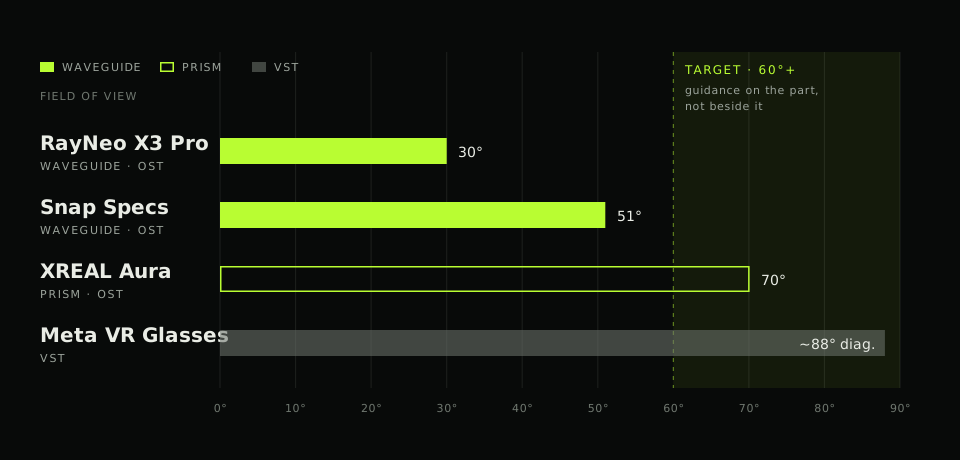
Meanwhile, prism optics and VST are delivering much larger digital workspaces at increasingly competitive prices. XREAL has since confirmed Aura pricing from $1,279 — less than the 30° RayNeo X3 Pro, for more than twice the field of view. If waveguides can't close that gap, the market may simply move past them — even for the work they suit best.
The device field work is waiting for
For technician assistance, maintenance and hands-free spatial guidance — the work MEMO Maritime is built for — the ideal device would combine:
- Waveguide OST, so the world stays direct.
- A wider field of view, ideally 60° or more, so guidance can sit on the equipment rather than beside it.
- Higher display resolution, for text, diagrams and part numbers.
- Lightweight glasses that can be worn for a whole shift.
- External compute on Snapdragon Reality Elite, keeping heat and weight off the face.
- Open spatial APIs and persistent anchors, so a note left on a pump is still there on the next visit.
Nothing on the market combines all six today. Snap's new Specs show another path forward — waveguide OST, a 51° field of view and standalone spatial computing — but at $2,195 they sit in a different price category.
The goal is not simply a larger virtual display. It is to add more intelligence without compromising how people see and interact with reality.
What to watch in the next twelve months
The open question is whether the next year brings waveguide glasses with a substantially larger field of view, higher resolution and external compute at a more accessible price. That would be a meaningful development for spatial AI — and for anyone who needs guidance while their hands are busy.
At Ruvi XR Labs, we build systems that help people interact with the physical world. For that kind of work, the future of smart glasses may depend as much on optical architecture as on AI.